OCRL Project: LQR-Based Balance Control for a Bipedal Wheel Robot
Designed and simulated an LQR + Virtual Model Control (VMC) framework to stabilize a planar bipedal wheeled robot with a five-bar leg mechanism, enabling upright posture regulation and coordinated wheel/leg torque allocation.
Links
Objective & Metrics
Bipedal wheeled robots combine leg agility with wheel efficiency, but balance is challenging due to nonlinear, underactuated dynamics and configuration-dependent behavior. The goal is stable upright posture while coordinating wheel and hip torques through a lightweight controller suitable for real-time use.
Introduction
This OCRL course project studies balance control for a planar bipedal wheeled robot with a five-bar leg mechanism. Because the system is nonlinear and underactuated, control performance depends on configuration (e.g., effective leg length), motivating a controller that is both model-based and adaptive to geometry.
We design a full-state LQR controller around an upright equilibrium for posture regulation, then use Virtual Model Control (VMC) to map task-space objectives into joint torques.
System Pipeline
- Model reduction: reduce the five-bar leg structure to a tractable planar model.
- Linearization: linearize about the upright equilibrium and write state-space form.
- LQR synthesis: solve the continuous-time ARE offline and compute
u = -Kx. - Gain scheduling: precompute gains vs. leg length and interpolate
K(L₀)online. - VMC mapping: convert virtual forces to joint torques via
T = JᵀF.
Methods
Dynamic Modeling & Linearization
- Derive coupled dynamics (Newton–Euler) and rewrite as first-order state-space.
- State includes positions/angles and velocities; inputs include wheel torque + hip torque.
- Linearize the model around the upright equilibrium for LQR design.
LQR with Gain Scheduling
- Compute LQR gains offline for discrete effective leg lengths.
- Fit low-order polynomials to each gain entry vs. leg length.
- Interpolate
K(L₀)online using current geometry (no online Riccati solve).
Virtual Model Control (VMC)
- Define virtual spring–damper forces in task space for support and damping.
- Map virtual force to joint torques using
T = JᵀF.

Experimental Setup
Controllers are evaluated in MATLAB simulation using the planar model. The closed-loop pipeline includes full-state feedback, upright posture references, online gain scheduling, and torque command generation for wheel and leg actuators.
- Full-state feedback (simulated positions/angles and velocities).
- Near-upright pitch reference + forward velocity target (if applicable).
- Online evaluation of
K(L₀)via scheduled gain model. - Torque allocation through VMC for leg tasks + wheel propulsion.
Results
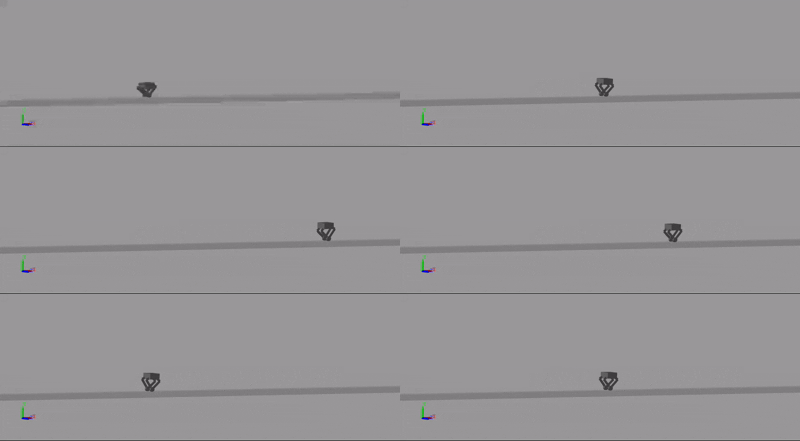
Simulation indicates the controller maintains upright balance and coordinates wheel/leg torques during cyclic motions. Body pitch remains near zero while legs swing, and torque commands remain smooth without abrupt spikes.
- Posture regulation: stable upright body pitch during motion.
- Torque coordination: smooth wheel and hip torques with higher demand during transitions.
- Tracking behavior: leg-speed tracking aligns with commanded profiles in simulation.
- Motion validity: animations confirm stable gait execution without loss of balance.
Discussion
Combining LQR (body regulation) with VMC (task-to-torque mapping) yields a modular control structure. Gain scheduling adapts feedback gains to changing leg geometry while keeping runtime computation lightweight.
Hardware deployment would require handling parameter uncertainty, sensor noise, and ground interaction variability (e.g., friction changes). Future work could add robustness analysis (e.g., disturbance rejection) and/or learning-based adaptation to refine gains online.
My Contribution
- Formulated the state-space model used for LQR design.
- Implemented LQR synthesis and gain scheduling in MATLAB.
- Developed VMC mapping from task-space forces to joint torques.
- Ran simulations, generated plots, and summarized results for the final report.
- Built this project webpage and organized the narrative and artifacts.